
Three-Factor Risk Model Dashboard
Model Framework
This project implements the Fama–French Three-Factor Model, which explains asset returns as compensation for exposure to systematic risk factors beyond the market portfolio. Formally, the model expresses excess returns as:

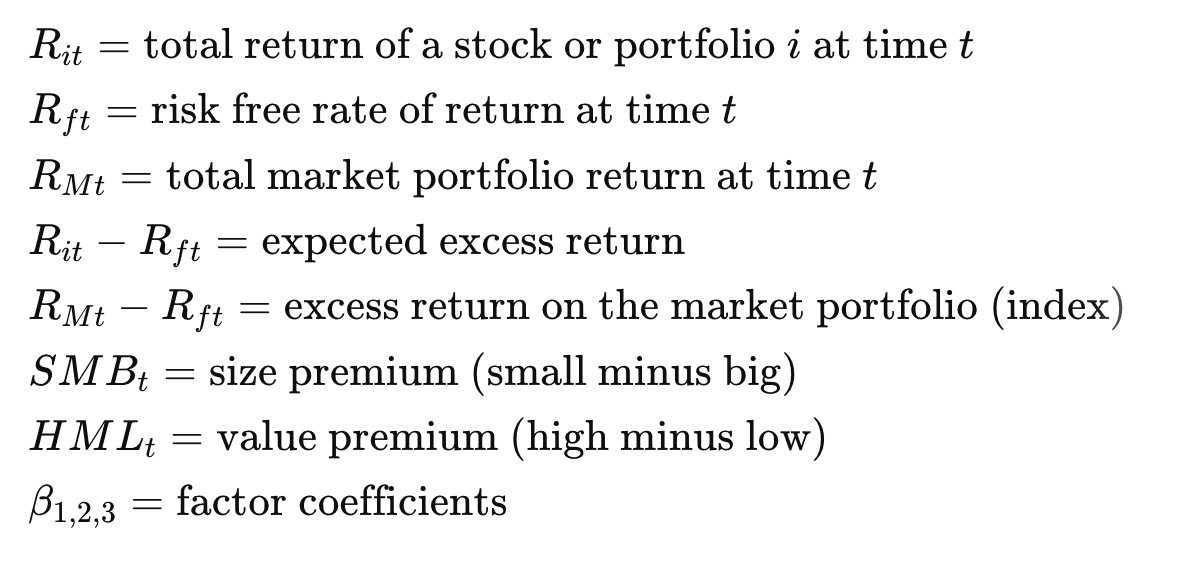
Rather than treating these coefficients as static estimates, the application applies rolling-window regressions to examine how factor exposures evolve through time, allowing users to observe changes in risk behavior across different market regimes.
Factor Construction
The factors used in the project follow standard definitions from the academic literature:
Market Factor (MKT–RF): Excess return of the market over the risk-free rate
Size Factor (SMB): Return spread between small-cap and large-cap portfolios
Value Factor (HML): Return spread between high book-to-market (value) and low book-to-market (growth) portfolios
All factor data is sourced from Kenneth R. French’s Data Library, ensuring consistency with canonical academic implementations.
Risk & Return Analytics
The application focuses on asset-level and cross-asset diagnostics, computing:
Risk-adjusted performance metrics (volatility, Sharpe ratio, drawdowns)
Factor loadings, identifying the primary drivers of returns
Alpha estimates, measuring residual performance after controlling for systematic risk
Rolling stability metrics, revealing how factor relevance changes over time
Rather than forecasting returns, the framework emphasizes explanatory power and risk attribution, allowing users to compare assets based on why they behave the way they do.
Interpretation Philosophy
A central design principle of the project is economic interpretability. Each factor represents a persistent risk premium tied to real-world constraints:
Market beta reflects exposure to aggregate economic growth and contraction
The size factor captures liquidity risk and financing constraints faced by smaller firms
The value factor represents compensation for balance sheet and earnings uncertainty
By visualizing these components interactively, the application highlights how diversification behaves when factor correlations shift—particularly during periods of stress.
Academic Inspiration
This project is inspired by foundational and modern research in asset pricing, including:
Fama, E. F., & French, K. R. (1993)
Common Risk Factors in the Returns on Stocks and Bonds
Journal of Financial EconomicsFama, E. F., & French, K. R. (2015)
A Five-Factor Asset Pricing Model
Journal of Financial EconomicsSharpe, W. F. (1964)
Capital Asset Prices: A Theory of Market Equilibrium under Conditions of Risk
Journal of FinanceCochrane, J. H. (2005)
Asset Pricing
Princeton University Press
These works form the theoretical foundation for factor-based investing and motivate the project’s emphasis on systematic risk, economic intuition, and transparent modeling.